
The long road to the white coat
The “Get2Germany” platform supports doctors from abroad through the recognition process
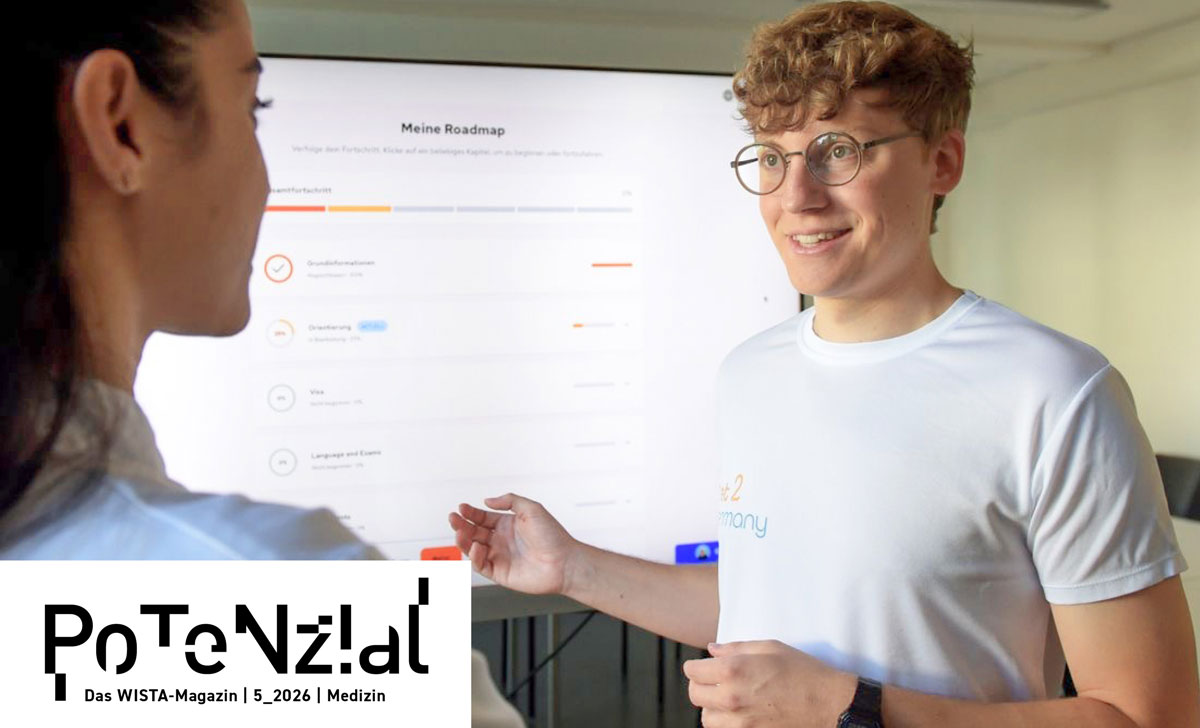
The shortage of medical professionals often begins long before hospitals and medical practices. Between language exams, professional licensing and federal bureaucracy, international doctors lose valuable time. The start-up Get2Germany turns the labyrinth into a manageable journey.
A doctor from India wants to work in Germany. Even before applying for a visa, she has to gather certificates, commission translations, obtain certified copies and answer a question that will determine the course of her entire career: Which federal state should she work in? Berlin, Brandenburg or Bavaria? The answer determines the authorities involved, deadlines and procedures. Only then does the actual journey begin. For many international doctors, it takes two and a half years.
René Rheimann knows the process inside out. The physician studied at Charité – Universitätsmedizin Berlin and, while still a student, ran a vaccination centre during the coronavirus pandemic. It was there that he first worked closely with doctors who still had to obtain their professional licence in Germany. Almost every conversation sooner or later came back to the same issues: missing information, conflicting responsibilities and lengthy procedures.
“Everyone talked about problems with the recognition process,” Rheimann recalls. “It became clear to us relatively early on that we wanted to build a platform specifically for this.”
In spring 2024, he and his co-founder, business IT specialist Pasha Alidadi, founded Get2Germany. Today, the company, based at the Startup Villa of Freie Universität Berlin in Berlin’s south-western innovation hub, supports more than 3,500 doctors from over 80 countries. The platform translates a highly complex administrative process into a comprehensible sequence of individual steps—from choosing a federal state and taking language exams to document management and securing a first position in a hospital.
“Although the recognition process itself follows fixed rules,” explains Rheimann, “in practice it resembles a labyrinth.” The requirements and documents vary depending on the country of origin. Then there are 16 federal states, each with its own procedures. The authorities involved include health authorities, medical associations, language schools, translation services, visa authorities and immigration offices. For someone who does not yet speak German, this creates a system that even professionals cannot immediately see their way through.
Anyone who studied medicine outside the European Union must first learn German to a certain level and then pass a medical German language examination. This is followed by recognition of their training documents, a temporary professional permit and, finally, the knowledge examination, whose requirements broadly correspond to the German state examination. Only then is a full medical licence granted. “But as a doctor, you don’t have to understand all that complexity yourself,” says Rheimann. “We’ve already done that.”
Get2Germany explicitly does not see itself as a conventional recruitment agency. For the company, the focus is not on job vacancies but on the people behind the CVs. The platform combines digital processes with personal advice and continuously analyses experience from thousands of individual cases. Many problems are similar, even though every biography is different. That is where the real added value lies.
The project also highlights a structural peculiarity at political level. Although Germany urgently needs medical professionals, recognition remains largely organised on a federal-state basis. Some moves towards greater standardisation are under way. But a single nationwide procedure is not yet in sight. Over the years, the federal states have developed their own structures—slow and often bureaucratic, but functional.
While politicians debate responsibilities, everyday life goes on. International doctors learn German, gather documents, wait for official decisions, and prepare for examinations. Eventually, their first shift at a hospital really does begin. But that does not mark the end of their journey. It is merely their provisional destination.
Rico Bigelmann for Potenzial
Medical Recognition in Germany - Get2Germany